


PLANB Value Chain
Plan B Media Public Company Limited operates an end-to-end business across the entire value chain, encompassing site acquisition, media development and installation, media and display management, content creation, marketing and sales strategizing, and customer service.
Our operations cover both owned and managed media nationwide. The Company strives to enhance efficiency across all processes while delivering stakeholder value, focusing on media quality, superior customer experiences, and fair, appropriate pricing. We utilize media effectiveness measurement tools and provide comprehensive after-sales services to strengthen customer satisfaction and foster long-term relationships.

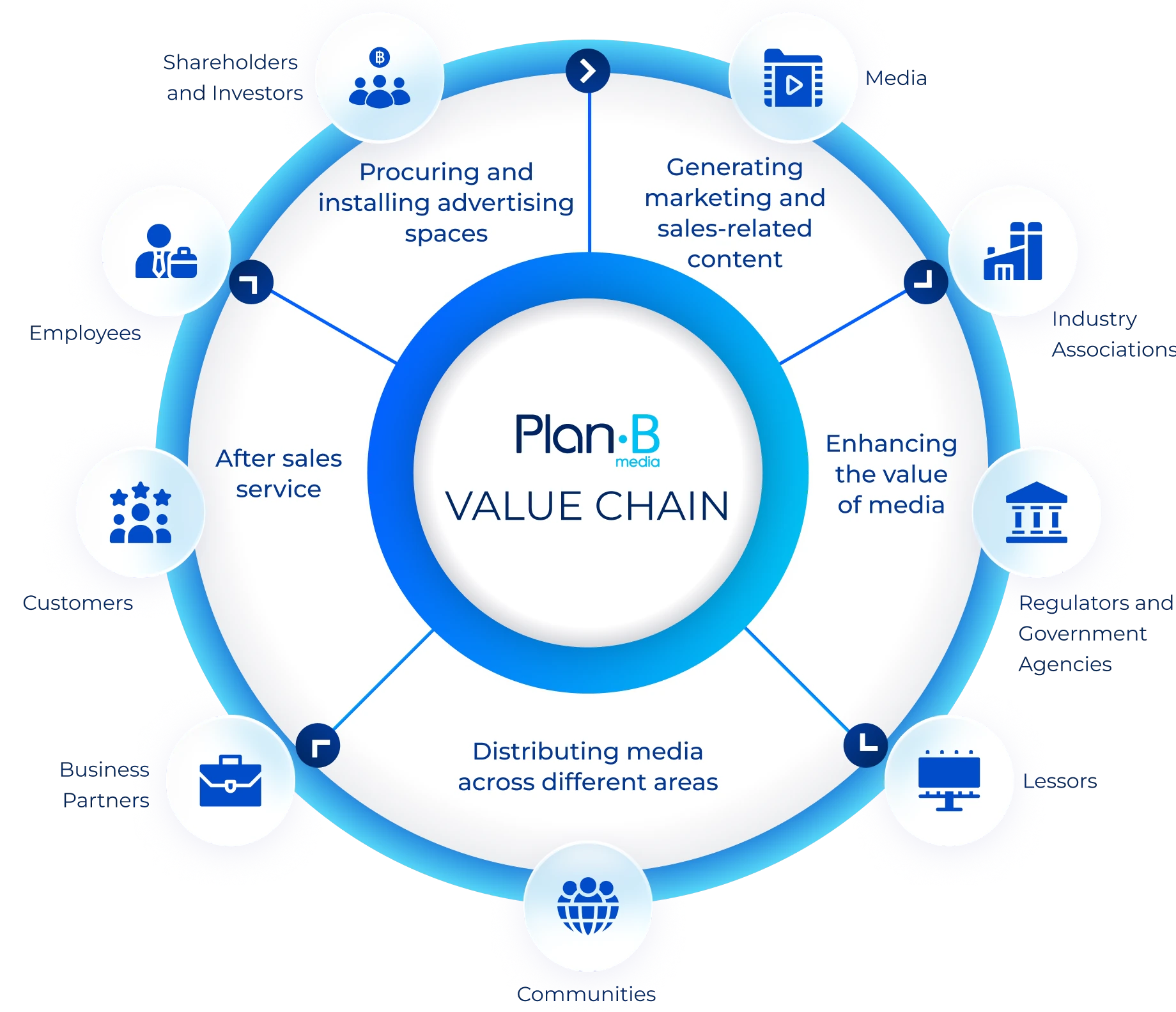
Value Chain Structure and ESG Integration
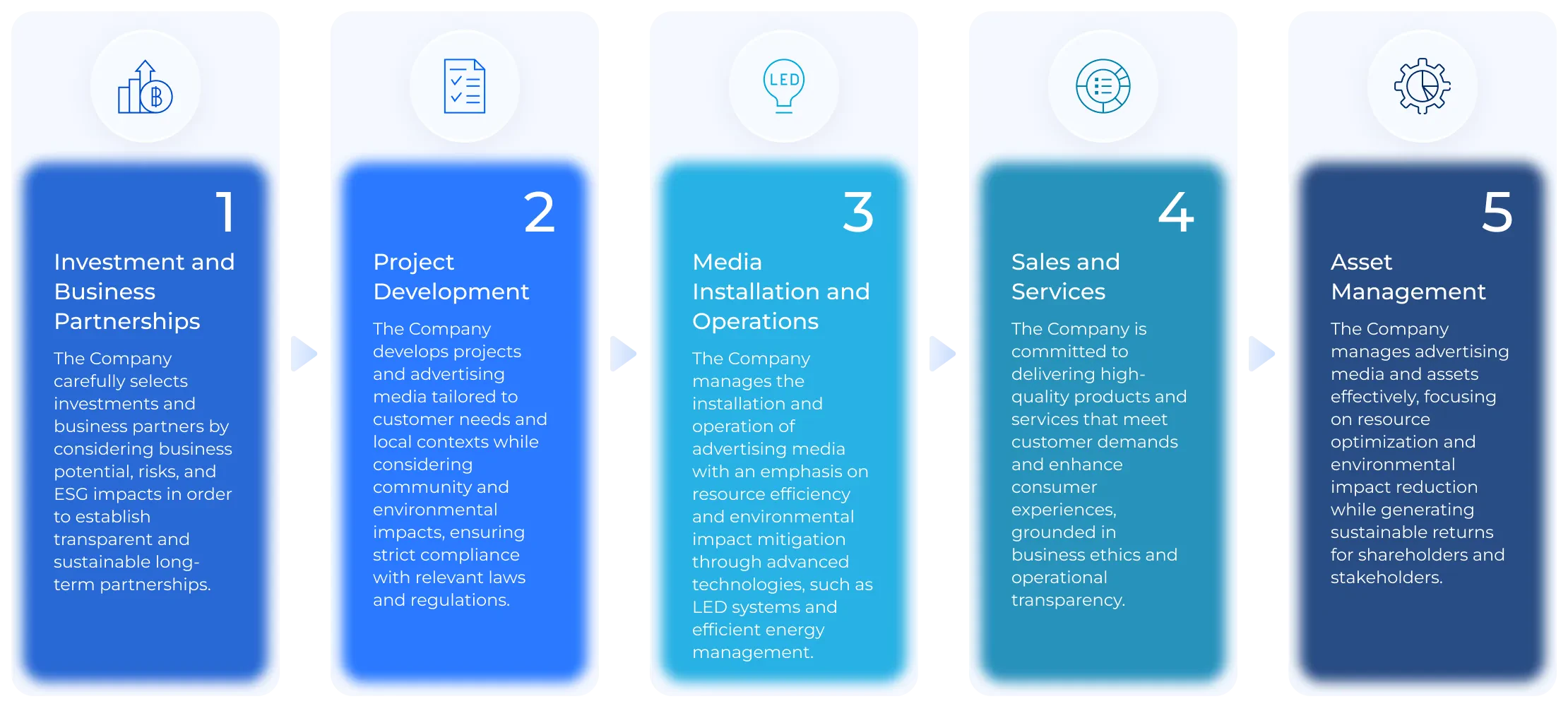
Plan B’s business operations encompass five core activities, with ESG integration strategies as follows:
| Relevant Stakeholders | ESG Integration | |
|---|---|---|
 1. Investment The Company carefully selects investments and business partners by considering business potential, risks, and ESG impacts in order to establish transparent and sustainable long-term partnerships. |
|
|
 2. Project Development The Company develops projects and advertising media tailored to customer needs and local contexts while considering community and environmental impacts, ensuring strict compliance with relevant laws and regulations. |
|
|
 3. Media Installation and Operations The Company manages the installation and operation of advertising media with an emphasis on resource efficiency and environmental impact mitigation through advanced technologies, such as LED systems and efficient energy management. |
|
|
 4. Sales and Services The Company is committed to delivering high-quality products and services that meet customer demands and enhance consumer experiences, grounded in business ethics and operational transparency. |
|
|
 5. Asset Management The Company manages advertising media and assets effectively, focusing on resource optimization and environmental impact reduction while generating sustainable returns for shareholders and stakeholders. |
|
|
Sustainable Supply Chain Management
The Company places importance on responsible supply chain management by establishing a Supplier Code of Conduct, which covers Environmental, Social, and Governance (ESG) matters, to serve as a guideline for conducting business together.
The Company screens all suppliers and requires them to acknowledge and comply with ESG requirements, as well as provide relevant business information for use in assessing supply chain risks, particularly those related to environmental, social, and governance matters. In addition, the Company has established a systematic supplier risk assessment process, requiring suppliers to conduct ESG self-assessments in order to classify risk levels and determine appropriate control and monitoring measures.
The Company regularly monitors and evaluates supplier performance, covering both the quality of products and services and ESG performance, to ensure that suppliers’ operating standards are aligned with the Company’s sustainability approach and that potential risks can be managed effectively. In the event that risks or issues that may cause impacts are identified, the Company will establish corrective measures and continuously monitor their implementation in order to mitigate impacts and enhance suppliers’ operating standards.
The Company strongly believes that sustainable supply chain management is a key foundation for building strong business partnerships and growing together over the long term. Therefore, the Company focuses on strengthening collaboration in sustainable business development across all dimensions through an integrated and continuous approach. The Company also regularly provides safety training to new suppliers involved in project work and advertising media installation, as well as suppliers with safety-related risks, in order to enhance working standards to achieve the highest level of safety, reduce potential risks, and strengthen mutual trust. This reflects the Company’s commitment to promoting stable and sustainable growth together.
