


Corporate Governance and Business Conduct
Supporting the Sustainable Development Goals
Plan B adheres to a strong ethical framework supported by efficient, transparent, and integrity-based management, which serves as the vital foundation for our operations and the driving force behind our sustainable growth. The Company operates with honesty, accountability, and fairness to enhance trust among all stakeholder groups, having implemented a comprehensive anti-corruption policy while integrating Environmental, Social, and Governance (ESG) factors into our corporate strategy. Furthermore, Plan B is dedicated to continuously enhancing our clients' business potential to promote sustainable value creation for stakeholders throughout the value chain.


Goals and Performance Highlights
| Sustainability Targets | 2025 Performance | |
|---|---|---|
| Long term (2026-2030) | Short term (2026) | |
| Maintain certification as a member of the Thai Private Sector Collective Action Against Corruption (CAC) | Zero incidents of corruption and serious business ethics violations across the value chain | 100% of employees completed business ethics training |
| 100% of employees completed business ethics training | 100% of employees completed business ethics training | No significant warnings or investigations from regulatory authorities |
| Achieve an “Excellent” Corporate Governance rating | Achieve an “Excellent” Corporate Governance rating | Achieve an “Excellent” Corporate Governance rating |

Goals and Performance Highlights
Commitment, Challenge and Opportunity

Commitment
-
The Company is committed to conducting business with transparency, accountability, and adherence to ethical practices, guided by the principles of good corporate governance and international standards. This approach aims to build stakeholder trust and promote sustainable development.

Challenges
-
Compliance with complex regulations
Maintaining transparency and ethical standards in a fast-changing business environment shaped by evolving laws, technologies, and societal expectations.
-
Integrating ethics into organizational culture
Ensuring that employees at all levels genuinely understand and follow ethical principles requires clear communication, comprehensive training, and strong leadership role models.

Opportunities
-
Building a sustainable corporate culture
Embedding business ethics and governance principles fosters employee pride and motivation, while strengthening a fair and transparent work environment.
-
Enhancing trust and credibility
Operating with transparency and ethics helps secure long-term confidence from investors, partners, customers, and society.
Corporate Governance
Good corporate governance, including operating with integrity and transparency, serves as the essential foundation for Plan B’s business operations and sustainable growth. The Company is committed to conducting business under the principles of good corporate governance and business ethics to promote fairness and build trust among all stakeholder groups.


Plan B has established its business structure, management systems, and corporate governance framework to align with and support the regulations of relevant authorities, such as the Corporate Governance Principles of the Stock Exchange of Thailand (SET), the Securities and Exchange Commission (SEC), and the recommendations of the Thai Institute of Directors (IOD), as well as other relevant international standards to ensure a robust governance framework. The Board of Directors is designed with Board Diversity in mind, encompassing gender, skills, experience, and specialized expertise, with an appropriate proportion of independent directors to ensure transparent checks and balances and to facilitate independent strategic decision-making free from conflicts of interest.
Furthermore, the Board of Directors has established and implemented the Corporate Governance and Business Ethics Manual to serve as a guideline for directors, executives, and employees at all levels, ensuring that operations strictly adhere to good governance principles. The Board reviews and updates this manual annually to ensure continued alignment with changing circumstances and international best practices.
Governance Structure
The Company has designed its corporate governance structure to promote operations in accordance with good governance principles, ensuring compliance with laws, corporate objectives, company regulations, and shareholder resolutions. We perform our duties with integrity and due care to safeguard the interests of shareholders and stakeholders over both the short and long term, ensuring that the Company’s operations are directed toward maximizing benefits for all shareholders and stakeholders.
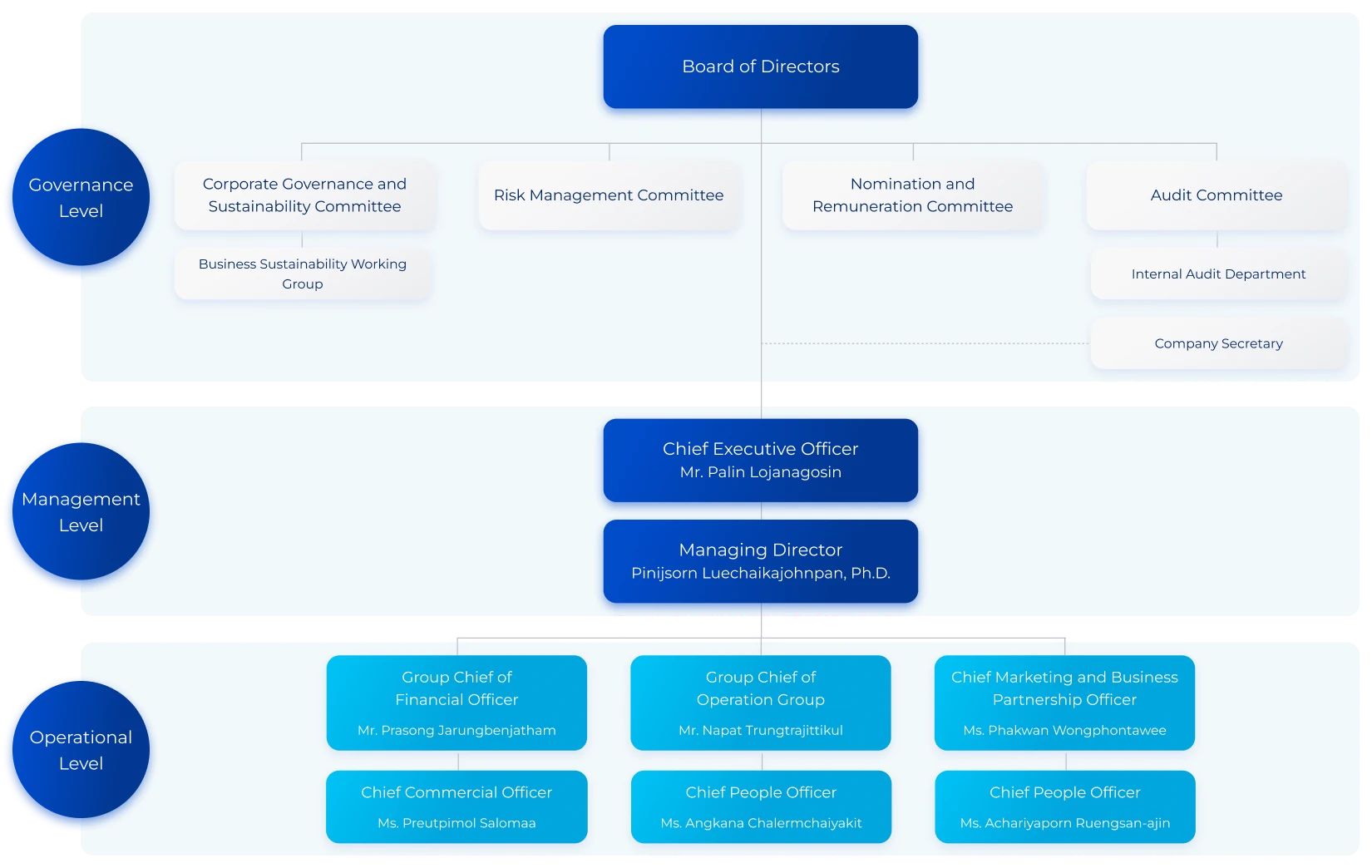
Note:
- Ms. Phakwan Wongphontawee resigned from the Company, effective 1 May 2025
- Ms. Angkana Chalermchaiyakit resigned from the Company, effective 25 December 2025
Board of Directors Structure
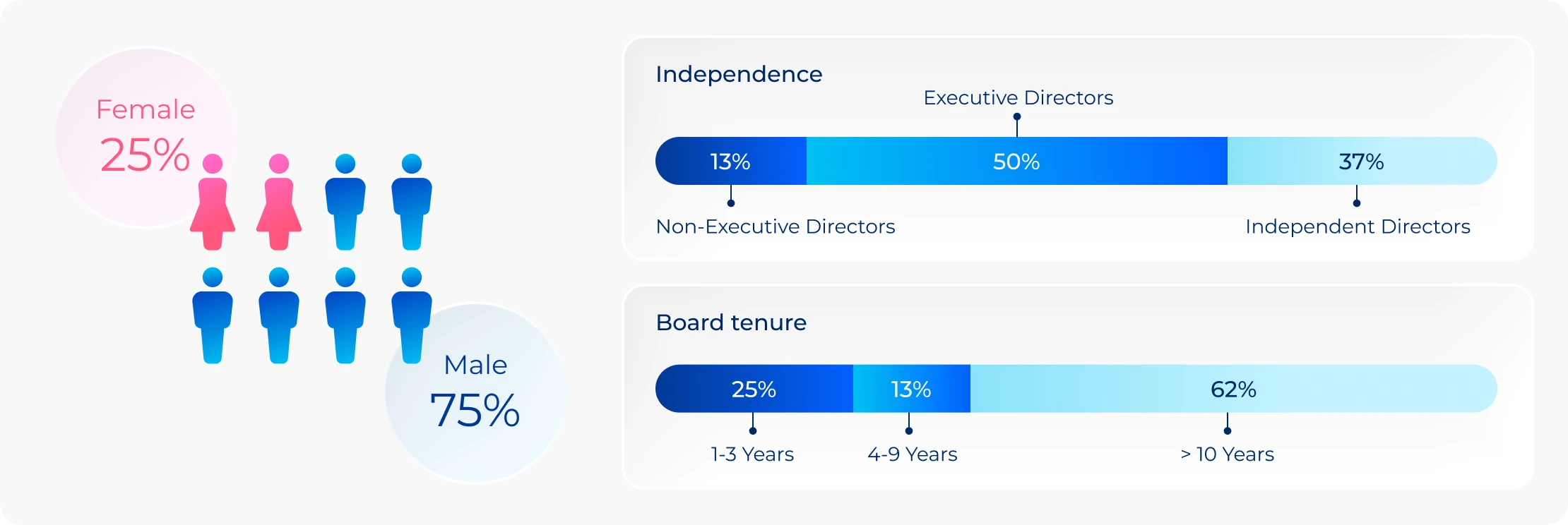
The Board of Directors comprises members possessing extensive knowledge, competence, and business experience, responsible for establishing the Company’s policy, vision, strategy, goals, and mission. This involves an annual review and approval of the vision, mission, and strategy, alongside budget determination and the oversight of management to ensure effective and efficient execution in alignment with established policies. All duties are performed within the regulatory framework of laws, objectives, company regulations, and resolutions from both shareholders and the Board, upholding accountability, integrity, and due care according to best practices to maximize economic value and long-term stability for shareholders. The Board of Directors consists of 8 members as follows:
-
Pennapha Dhanasarnsilp, Ph.D.
Independent Director / Vice Chairman / Chairperson of the Audit Committee / Chairperson of the Nomination and Remuneration Committee / Chairperson of the Corporate Governance and Sustainability Committee
-
Mrs. Monluedee Sookpantarat
Independent Director / Member of the Audit Committee / Member of the Nomination and Remuneration Committee / Member of the Risk Management Committee
-
Mr. Mana Jantanayingyong
Independent Director / Chairperson of the Risk Management Committee / Member of the Audit Committee
-
Mr. Palin Lojanagosin
Director / Chief Executive Officer
-
Pinijsorn Luechaikajohnpan, Ph.D.
Director / Managing Director / Member of the Nomination and Remuneration Committee / Member of the Risk Management Committee
-
Mr. Arnon Porndhiti
Director / Member of the Risk Management Committee / Member of the Corporate Governance and Sustainability Committee
-
Mr. Prasong Jarungbenjatham
Director / Member of the Corporate Governance and Sustainability Committee
-
Mr. Lap Shun Nelson Leung
Director
Board Diversity
Plan B recognizes that board diversity is a crucial mechanism for good corporate governance and a key factor in enhancing the effectiveness of strategic decision-making. The Company prioritizes the recruitment and appointment of directors based on the principles of diversity and inclusion, without restrictions regarding gender, age, ethnicity, religion, or professional expertise. This ensures the Board possesses a broad vision, capable of comprehensive risk assessment and responding to the expectations of all stakeholder groups in a balanced manner. The details are as follows:
Nomination and Appointment of Directors, the CEO, and Executives
The Nomination and Remuneration Committee is responsible for the selection of directors, the Chief Executive Officer, and executives, taking into account the diversity of qualifications, experience, suitability, and professional competency. Further details regarding these nomination and appointment processes are available in the Criteria for the Nomination and Appointment of Directors, Chief Executive Officer, and Executives.
Business Ethics
Plan B recognizes that transparent operations and steadfast adherence to business ethics are essential factors in fostering the organization’s sustainable development and building trust and confidence among all stakeholder groups. Consequently, the Board of Directors has established and implemented the Corporate Governance and Business Ethics Manual as a guideline for directors, executives, and employees at all levels, including those within subsidiaries. The Board is responsible for reviewing and updating this manual annually to ensure its alignment with the evolving business landscape, legislative changes, and international best practices.

This manual covers key requirements and essential guidelines across various areas, including:
Cultivating Corporate Culture and Practical Enforcement
To ensure the effective implementation of business ethics, the Company requires directors, executives, and employees at all levels to sign an acknowledgment and confirm their strict adherence to the manual. Furthermore, annual business ethics training and knowledge assessments are conducted, whereby from 2023 to 2025, 100% of employees attended the training and passed the assessments according to standard criteria with a 100% score, reflecting our steadfast commitment to cultivating a transparent and accountable corporate culture.
| Business Ethics Training (%) | 2023 | 2024 | 2025 |
|---|---|---|---|
| Employees Attended | 100 | 100 | 100 |
| Employees Passed the Assessment | 100 | 100 | 100 |
| Average Employee Score | 100 | 100 | 100 |
Governance and Business Ethics Performance
Driven by a commitment to fostering a transparent corporate culture and upholding integrity, Plan B successfully achieved its core corporate governance targets. Notably, in 2025, there were no reported disciplinary breaches regarding business ethics, demonstrating the efficacy of our internal control systems and rigorous policy adherence. The details are as follows:
| Business Ethics Violations (Cases) | 2023 | 2024 | 2025 |
|---|---|---|---|
| Total business ethics violation cases received | |||
|
0 | 0 | 0 |
|
0 | 0 | 0 |
|
0 | 0 | 0 |
| Number of business ethics violation cases by category | |||
|
0 | 0 | 0 |
|
0 | 0 | 0 |
|
0 | 0 | 0 |
|
0 | 0 | 0 |
|
0 | 0 | 0 |
|
0 | 0 | 0 |
|
0 | 0 | 0 |
|
0 | 0 | 0 |
|
0 | 0 | 0 |
Monitoring Business Ethics Compliance
Plan B prioritizes the concrete implementation of policies. The Company has established a continuous process for monitoring and evaluating business ethics compliance. Our Internal Audit unit operates independently to systematically assess risks, conduct audits, and report on governance performance. This ensures that personnel at all levels across the entire value chain adhere to a transparent corporate culture and remain accountable to all stakeholder groups.

To maintain effective and transparent oversight, the Company prepares Business Ethics Compliance Reports for Audit Committee on a quarterly basis. These reports cover:
- Ethics compliance assessment results for employees and relevant stakeholders
- Whistleblowing reports including investigations and actions taken in cases of violations
- Systematic recommendations and preventive measures
Following the Audit Committee review, these reports are presented to the Board of Directors to determine policies and improvement directions. This reflects robust corporate governance from the highest executive levels. The Company has also integrated modern tools for rigorous monitoring and surveillance of ethical risks comprising:
- Employee Self Assessment Questionnaires
- Reviews of performance reports related to ethical issues
- Secure and confidential Whistleblower Channels allowing employees and stakeholders to raise concerns anonymously
Regarding awareness promotion, the Company provides regular training and internal communication. This ensures that employees at all levels possess a deep understanding of business ethics and can correctly apply them in real world situations.
The Company maintains standardized and fair investigation procedures. Upon receiving a report, an investigation committee is appointed to complete fact finding within the designated timeframe. If a violation is confirmed, strict disciplinary actions are taken which may include termination or legal proceedings. Business ethics policies are reviewed annually to remain current with evolving business landscapes and laws. Due to rigorous enforcement and consistent awareness initiatives, the Company reported zero business ethics violations in 2025. This outcome validates the effectiveness of our internal control systems and a corporate culture firmly rooted in governance principles.
Anti Corruption
The Company focuses on sustainable business practices by prioritizing good corporate governance and adequate internal control systems. We have established a clear and comprehensive the Anti Corruption Policy with precise definitions of corruption and operational guidelines communicated to both internal and external stakeholders. Furthermore, the Company conducts audits and assessments to identify corruption risks across its business activities. Control and monitoring measures are implemented for processes susceptible to misconduct to ensure operational integrity and transparency. We also maintain communication channels for stakeholders to report whistleblowing leads, suggestions, or complaints regarding corruption directly to the Audit Committee.

Membership in the Thai Private Sector Collective Action Against Corruption (CAC)
Plan B has formally pledged its intent to combat corruption and has maintained certification as a member of the Thai Private Sector Collective Action Against Corruption (CAC) for nine consecutive years since 2016. This achievement underscores our dedication to transparent operations and good governance in alignment with national standards. We adhere to business ethics and conduct operations with responsibility toward the community, society, the environment, and all stakeholders across the supply chain. Our sustained CAC certification provides empirical proof of our zero tolerance policy toward corruption in any form.
Anti Corruption Guidelines
Personnel at all levels of the Company must strictly adhere to the following established guidelines:
- Commitment to the Zero Tolerance Policy Every individual must strictly comply with the Anti Corruption Policy, the Code of Conduct, and internal regulations. No person shall engage in any form of corruption or bribery, whether direct or indirect, to demonstrate our steadfast commitment to business transparency.
- Prohibition of Bribery Any action indicating intent to offer or receive bribes from stakeholders regarding assigned responsibilities, whether directly or indirectly, for the benefit of the organization or associated parties, is strictly forbidden.
- Whistleblowing and Reporter Protection Personnel must not ignore or neglect behaviors that may constitute corruption and are obligated to report such incidents to supervisors or through designated channels. The Company provides robust protection measures for whistleblowers and those who refuse corruption, ensuring no demotions, penalties, or negative repercussions, even if such refusal results in lost business opportunities.
- Caution in High Risk Activities Operations involving potential corruption risks must be conducted with extreme caution. If legal or regulatory uncertainties arise, personnel must seek written consultation from the Compliance or Legal Department before proceeding. Special focus is required for the following areas:
- Gifts and Hospitality The receiving or providing of gifts and hospitality must strictly comply with the guidelines defined in the Corporate Governance Manual regarding the Gift Policy. Such actions must be conducted with transparency and reasonableness, ensuring they are never utilized as tools to influence business decisions.
- Charitable Donations Donations must be executed in the Company’s name to support organizations with legitimate social objectives. These entities must be credible and verifiable, with all contributions following formal approval procedures to prevent donations from being used as a pretext for bribery.
- Sponsorships Sponsorship funds must be clearly attributed to the Company with the intent of promoting business operations and a positive corporate image. All sponsorships must undergo transparent approval processes and remain legally verifiable.
- Public and Private Sector Procurement Business relationships, procurement, and transactions with both the public and private sectors, including interactions with government officials or relevant parties, must be conducted with honesty and transparency in full compliance with applicable laws.
- Political Neutrality The Company maintains a firm policy of political neutrality. While all personnel possess legal political rights and freedoms, they must refrain from using Company resources or engaging in activities that compromise corporate neutrality or result in damage from political involvement. The Political Participation Policy has been implemented as a standard guideline for personnel at all levels.
- Integration into Human Resource Management Anti corruption policies are formally integrated into human resource processes, covering recruitment, training, performance evaluation, and promotion. Supervisors at all levels are responsible for communicating and ensuring strict policy compliance within their respective departments.
Penalties and Anti Corruption Whistleblowing
Negligence or non compliance with anti corruption guidelines constitutes a severe disciplinary breach and a violation of employment terms, which may lead to criminal prosecution. Such actions significantly impact the Company’s reputation and operational standing. Consequently, any employee or stakeholder witnessing corruption has an obligation to report to supervisors or via formal corporate channels immediately.
Whistleblowing and Grievance Channels
The Company provides secure and accessible whistleblowing mechanisms for all stakeholder groups. Corruption concerns can be reported directly to the Audit Committee, which comprises independent directors, through the following channels:
- By Mail to Audit Committee 1700 Plan B Tower, New Phetchaburi Road, Makkasan, Ratchathewi, Bangkok 10310
- By Email to Audit Committee auditcommittee@planbmedia.co.th
- By Email to Company Secretary companysecretary@planbmedia.co.th
- By Telephone +66 (0) 2530-8053-6 ext. 131 or 134
The Company ensures maximum confidentiality for all reports. Whistleblowers are fully protected under organizational measures stipulated in the Whistleblowing Policy.
Grievance Management Process
To ensure transparency and fairness, the Company has established standardized operating procedures as follows:
- Initial Screening Stage Upon receiving a report, the Company Secretary gathers and filters the submission. Issues unrelated to corruption are forwarded to the responsible departments for resolution. Regarding potential corruption matters, a preliminary assessment of evidence is performed. If a report is found to be groundless, the conclusion is communicated to the complainant.
- Reporting and Investigation Stage If a report is substantiated, the Company Secretary initiates the formal procedure. For urgent or severe cases, preliminary findings are reported to the Executive Committee and the Audit Committee with a copy provided to Internal Audit. The Secretary then coordinates with Human Resources to appoint a fact finding committee for further disciplinary action.
- Overview Reporting Stage The Company summarizes whistleblowing statistics, operational status, and investigation outcomes for reporting to the Audit Committee at least every six months. This process serves to monitor progress and evaluate the overall effectiveness of internal control systems.
Whistleblower Protection and Performance Results
Plan B places the highest priority on protecting the rights of whistleblowers and informants through its Non retaliation Policy. The Company ensures the confidentiality of names, addresses, and any personally identifiable information by maintaining all data under the strictest security. Stakeholders may refer to the Whistleblowing and Grievance Policy for further details.
As a result of robust governance and continuous awareness initiatives, Plan B received zero reports or whistleblowing leads regarding bribery and corruption through any channel in 2025. This outcome demonstrates the efficiency of our internal control mechanisms and serves as concrete evidence of our transparent business operations.
| Grievance Management (Cases) | 2023 | 2024 | 2025 |
|---|---|---|---|
| Total grievances received | |||
| Legal proceedings | 0 | 0 | 0 |
| Business ethics or corruption | 0 | 0 | 0 |
| Breach of business partner data privacy | 0 | 0 | 0 |
| Conflict of interest | 0 | 0 | 0 |
| Human rights including discrimination and harassment | 0 | 0 | 0 |
| Environmental, occupational health, and safety | 0 | 0 | 0 |
| Money laundering or insider trading | 0 | 0 | 0 |
| Grievance Resolution Actions | |||
| Verbal warning | 0 | 0 | 0 |
| Written warning | 0 | 0 | 0 |
| Under investigation | 0 | 0 | 0 |
| Termination of employment | 0 | 0 | 0 |
Awareness Building and Executive Oversight
Furthermore, the Company mandates that all employees undergo rigorous assessments on the Code of Conduct and Anti Corruption policies. Every employee is required to meet all passing criteria to ensure comprehensive awareness and cultivate ethical behavior. These communication and enforcement efforts are extended to business partners to foster a collective transparency network throughout the supply chain.
In terms of governance, the Managing Director and Chief Executive Officer are responsible for monitoring and ensuring the efficiency of anti corruption initiatives. Regular reports are submitted to the Chairman of the Board and the Audit Committee to review and update policies and control measures, ensuring continuous alignment with business evolution and international standards.
Expanding Governance to the Supply Chain
Plan B recognizes that building a transparent society requires collaboration from all sectors, especially business partners throughout the value chain. Over the past year, the Company has proactively promoted integrity values through the following initiatives:
- Open Letters to Business Partners The Company issued communications regarding its anti corruption policies and invited partners and business alliances to join the Thai Private Sector Collective Action Against Corruption (CAC). This effort aims to establish clean business standards and mitigate corruption risks within procurement processes and joint operations.
- Ethical Supplier Governance Beyond invitations, compliance with anti corruption policies is integrated into the Supplier Code of Conduct. This ensures that all stakeholders operate in alignment with the governance and ethical standards defined by the Company.
Stakeholders Directly Impacted

Shareholders and Investors

Employees

Customers

Business Partners

Communities

Landlords

Regulators and Government Agencies

Media