


Stakeholder Engagement
Stakeholders Engagement
Plan B is committed to driving our media business through a sustainable value chain. By integrating Environmental, Social, and Governance (ESG) dimensions into every decision and operational process, we create shared value and effectively meet the expectations of all stakeholders.
Through efficient resource management, elevated safety standards, and business ethics, we strengthen organizational resilience and ensure robust, long-term growth.
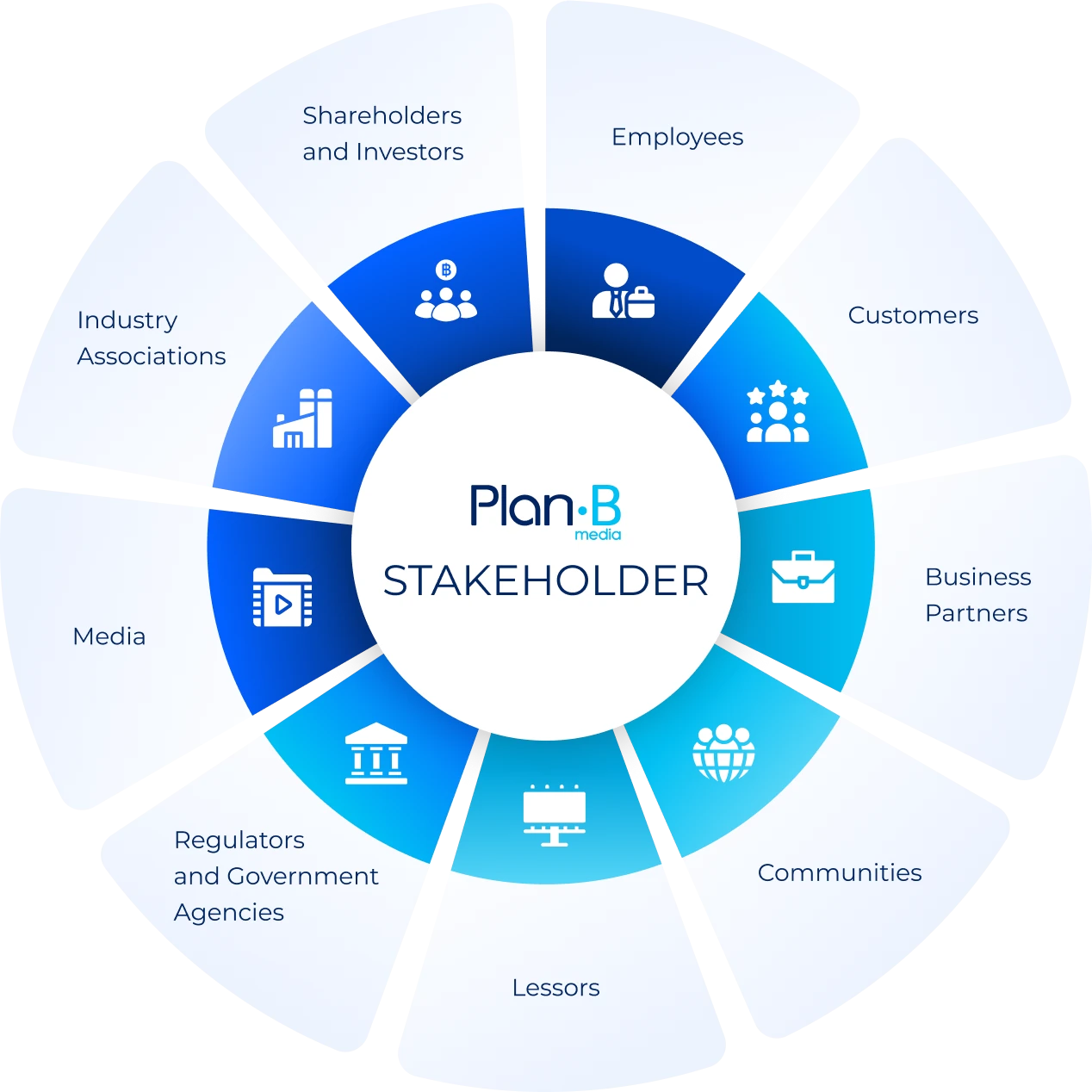
Stakeholder Identification And Prioritization
Stakeholder Identification and Prioritization is an important process under the Company’s sustainability framework. It enables the Company to manage risks, enhance transparency, respond to stakeholder expectations across all ESG dimensions, and drive responsible and sustainable business operations.
The results of stakeholder identification and prioritization are integrated into the Double Materiality Assessment process. The expectations and concerns gathered from stakeholders are reflected in the stakeholder significance axis of the materiality matrix, enabling the Company to allocate resources and formulate response strategies accurately and effectively. The key steps are as follows:
1. Stakeholder Identification
Companies typically engage with diverse stakeholder groups, ranging from individuals and groups to organizations, identified by their mutual influence or impact on the Company’s activities, products, and services. Each stakeholder group experiences varying levels of impact and benefit, resulting in distinct levels of engagement and specific areas of interest or concern regarding the Company’s operations.
This stakeholder identification process serves as a critical foundation for the Double Materiality Assessment. The Company has integrated stakeholder considerations throughout the entire value chain, from upstream and midstream to downstream, to ensure that all perspectives are heard and incorporated into the organization’s strategic direction.


Stakeholder identification for the engagement process should be conducted by the relevant internal departments responsible for those specific activities, in alignment with the defined objectives and scope.
Stakeholder identification may begin by brainstorming fundamental questions, such as identifying those for whom the Company provides products and services, those impacted by or influencing production, those with specific interests in the Company’s offerings, and those who supply goods and services. Subsequently, more specific questions aligned with the process objectives are utilized to systematically prioritize and map stakeholder relationships. The Company may categorize the scope of stakeholder engagement based on the nature of each group’s involvement as follows:
Principles for identifying stakeholders of the company
| Participation characteristics | Meaning |
|---|---|
| Dependency | Stakeholders who directly or indirectly depend on the Company’s operations, or those the Company relies upon to conduct its business. |
| Responsibility | Stakeholders to whom the Company holds legal, commercial, operational, or ethical responsibilities, both currently and in the future. |
| Tension | Stakeholders requiring close economic, social, or environmental support from the Company. |
| Influence | Stakeholders who influence the Company, shape the opinions of other groups, or impact strategic decision-making. |
| Diverse perspective | Stakeholders whose diverse perspectives drive innovation and identify novel or unprecedented practices. |
Source: Stakeholder Engagement Standard (SES)
Once stakeholders are identified by their engagement characteristics, the Company considers representatives of vulnerable groups or those with significant concerns but limited social influence. Within the Out-of-Home (OOH) media context, the Company prioritizes vulnerable groups, such as migrant workers employed by subcontractors for billboard installation or communities situated near large digital displays. To address this, the Company applies Human Rights Due Diligence (HRDD) to identify and prevent potential negative impacts on these groups comprehensively.
Concurrently, the Company remains vigilant regarding stakeholders who may not have a direct interest but could impact corporate reputation. Additional stakeholders may be identified after the engagement process begins, often through recommendations from existing stakeholders or internal personnel.
To align with sustainability principles, the Company considers stakeholders across the ESG framework:
Environmental
Local communities and government agencies potentially affected by resource consumption, waste generation, or ecological changes.
Social
Employees, business partners, customers, and vulnerable labor groups or communities at risk from corporate policies or practices.
Governance
Shareholders, investors, and regulators who promote transparency, accountability, and corporate governance.
These considerations enable the Company to design tailored engagement strategies and mitigate future ESG risks, fostering long-term stability. Consequently, the Company categorizes its stakeholders into nine key groups:
-
Shareholders/Investors
Capital providers and drivers of business growth, focused on long-term value creation and sustainable returns.
-
Employees
Critical drivers of corporate strategy and innovation who deliver exceptional experiences.
-
Customers
Business partners utilizing advertising space who expect innovative solutions and effective marketing results.
-
Business Partners
Key supply chain supporters who deliver quality services while maintaining safety and ethical standards.
-
Communities
Stakeholders for whom the Company mitigates environmental impacts while enhancing quality of life and creating shared value.
-
Lessors
Strategic partners providing advertising space to enhance local landscapes and generate economic value.
-
Regulators and Government Agencies
Policymakers and authorities who define legal frameworks and industry directions.
-
Media
Essential channels for accurate and transparent communication of corporate information and performance to the public.
-
Industry Associations
Collaborative networks that drive professional standards and promote the sustainable growth of the advertising industry.
2. Stakeholder Prioritization
Stakeholder Prioritization is an important step in analyzing and prioritizing stakeholder groups with whom the Company needs to engage, as well as in determining appropriate measures to carry out stakeholder engagement with key stakeholder groups within an appropriate timeframe. The Company has integrated value chain impact factors into the analysis process in order to determine measures and allocate resources as effectively as possible. The prioritization is based on two key factors as follows:
- Influence refers to the degree to which stakeholders have influence over the Company’s operations, including the power to effect change or influence decision-making in any aspect of the Company.
- Interest refers to the level of expectations or interest that stakeholders have in the Company’s performance, business activities, or potential impacts arising from the Company’s business operations.


Strategic Integration & Oversight
The insights gained from analyzing stakeholder influence and interest serve as critical inputs for the Double Materiality Assessment, enabling the Company to define corporate strategies with precision. Furthermore, in alignment with international corporate governance standards, the Board of Directors or the Sustainability Committee is tasked with reviewing the stakeholder mapping annually. This oversight ensures that engagement strategies remain current and capable of addressing emerging challenges in a timely manner.
Stakeholder Matrix
The prioritization of each stakeholder group’s influence and interest regarding the Company is conducted using a 4-level scoring system. The criteria for influence and interest are detailed as follows:
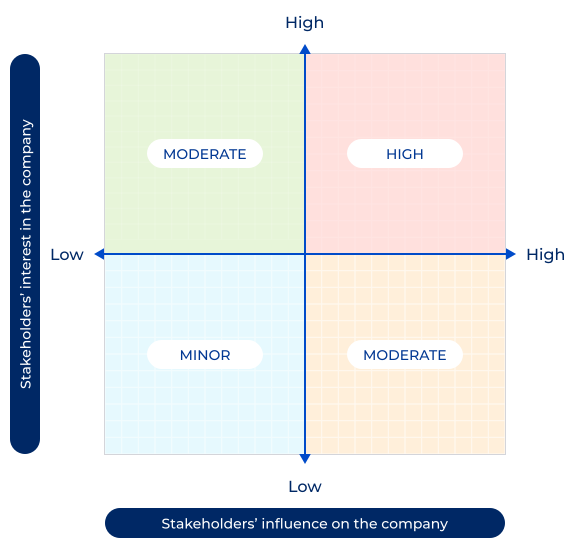
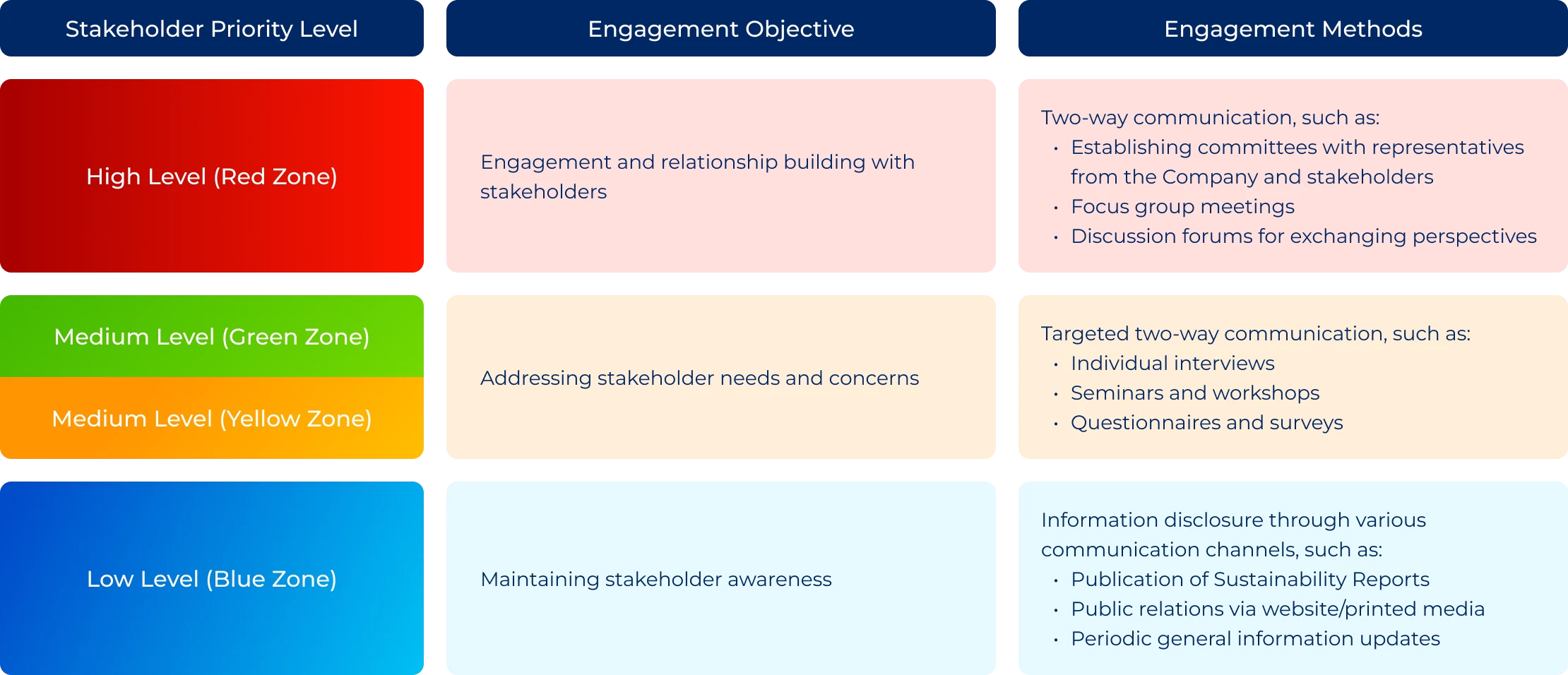
The prioritization of stakeholders within the Stakeholder Matrix can be categorized into four distinct groups:
- High Level (Red Zone) Stakeholders with high influence and high interest. The Company prioritizes this group as they are significantly impacted by and exert substantial influence over corporate operations.
- Medium Level (Green Zone) Stakeholders with high influence but low interest. While they are not significantly impacted by the Company’s operations, they possess considerable influence over them. The Company focuses on raising awareness and fostering a positive perception among this group.
- Medium Level (Yellow Zone) Stakeholders with low influence but high interest. This group is significantly impacted by the Company’s operations despite having limited influence. The Company should encourage engagement and consolidate their feedback to support operational effectiveness.
- Minor Level (Blue Zone) Stakeholders with low influence and low interest. These stakeholders are not significantly impacted by operations and hold minimal influence. While extensive management efforts are not required, the Company monitors them as a group with potential for increased influence or interest in the future.
Grievance Mechanisms
To ensure that stakeholder engagement aligns with international assessment criteria and the United Nations Guiding Principles on Business and Human Rights (UNGPs), Plan B has established a comprehensive corporate grievance mechanism covering environmental, social, and governance (ESG) aspects. The Company provides diverse, secure, and accessible reporting channels for stakeholders throughout the value chain, including vulnerable groups. To ensure maximum safety, complainants have the option to report concerns anonymously.
In terms of management, the Company strictly enforces a Whistleblower Protection Policy. The investigation process is conducted independently, transparently, and fairly, with defined timelines for resolution and appropriate remedial measures to address potential impacts. This robust mechanism not only facilitates risk management but also reinforces the Company’s commitment to transforming stakeholder feedback into a driving force for sustainable organizational development.
Stakeholder Engagement
The Company prioritizes the roles of all internal and external stakeholder groups, committing to fair, equitable, and appropriate treatment for all parties. Under the oversight of the Board of Directors, the Corporate Governance and Sustainability Committee is responsible for approving policies, reviewing engagement outcomes, and monitoring progress annually. This ensures that corporate strategies effectively address emerging challenges while fostering broad participation across operations to build strong relationships grounded in mutual trust and respect.
Furthermore, the Company believes that creating shared value with stakeholders serves as the vital foundation for sustainable development and long-term success. To this end, the Company has established safe and accessible grievance mechanisms for all stakeholder groups, ensuring transparency and protecting complainant rights in accordance with international standards. Comprehensive statistics on grievances and resolution outcomes are reported directly to the Audit Committee to maintain the highest level of corporate transparency.
Stakeholder Engagement Results and Responses for the 9 Key Groups
The outcomes derived from gathering stakeholder expectations, as detailed in the table below, have been integrated into our business plans and established as Key Performance Indicators (KPIs) for executives and relevant departments. This ensures the concrete advancement of our ESG strategy across all levels of the organization.

Key Interests
- Business Ethics and Transparency
- Business Performance and Competitive-
- ness
- Growth Trajectory and Future Outlook
- Information Disclosure
Actions and Responses
- Strictly comply with the Code of Conduct and policies imposed by the Company
- Conduct business in compliance with applicable laws and rules
- Strictly fulfil creditor conditions
- Disclose information with transparency and timeliness
- Responsive-ness to Shareholder and Investor Feedback
- Designated Functions for Shareholder and Investor Relations
Engagement Channels
- Annual General Meeting of Shareholders (AGM)
- Quarterly and annual earnings reports, disclosed via the Company's website and the Stock Exchange of Thailand (SET)
- Communication channels, including the corporate website, email, and telephone
- Whistleblowing and grievance channels
Value Creation
- Driving the organization towards sustainability
- Conducting business with transparency and accountability, supported by effective corporate governance
- Maintaining stable, sustainable, and growing business performance
- Regular and Consistent Disclosure of Operational Results
- Respecting Shareholder Rights and Ensuring Equitable Treatment


Key Interests
- Career Advancement and Pathing
- Training and Skill Development
- Compensa-tion, Benefits, and Incentives
- Occupational Health and Safety
- Transparency, Human Rights Respect, and Equitable Treatment
- Diversity, Equity, and Inclusion (DEI) and Holistic Physical and Mental Well-being
Actions and Responses
- Continuous Training and Development
- Talent Retention Programs
- Fair Compensation and Benefits
- Labor Law Compliance
- Respect for Human Rights Principles
- Grievance and Whistleblowing Channels
- Corporate Value Definition
- Anti-Discrimination and Human Rights Due Diligence (HRDD)
Engagement Channels
- Conversations, team meetings
- Meeting of all employees by top executives of the functions and/or the Company
- Intranet
- Employee engagement survey
- The Company’s website
- Whistleblowing channels
Value Creation
- Training for Career Advancement
- Continuous potential development
- Career stability and progression
- Occupational health, safety, and work environment assessments
- Formal grievance mechanisms
- Establishing a diverse organization that respects fundamental human rights

Key Interests
- Fair treatment
- Environmental Protection
- Strategic Media Locations
- Innovative Product Development
- Data Security and Privacy
- Resource Conservation
Actions and Responses
- Conduct business in strict compliance with applicable law
- Customer-Centric Products at Fair Pricing
- Dedicated Feedback and Grievance Management
- Sourcing raw materials from sustainable origins
- Environmental Conservation Initiatives
- Strict Adherence to Ethics and Policies
Engagement Channels
- Customer Service Center
- Annual Customer Satisfaction Surveys
- Customer Relationship Management (CRM) activities, such as networking and engagement events
- Grievance, suggestion, and feedback channels
- Whistleblowing and reporting channels
Value Creation
- Media and Product Credibility
- Delivering high-quality products that meet customer expectations at fair and appropriate prices
- Provide accurate and sufficient information for customers to make decisions
- Continuously develop the quality and form of products and services


Key Interests
- Business Ethics, Transparency, and Equality
- Future Strategic Direction and Business Growth
- Supplier Capacity Building
- Supplier ESG Risk Assessment and Human Rights in the Supply Chain
Actions and Responses
- Establish a Supplier Code of Conduct to define operational standards
- Develop collaborative partnership programs with strategic suppliers
- Designate responsible functions to manage supplier Communication and direct material issues
- Treat all suppliers with equity and fairness in accordance with the Business Code of Conduct
- Conduct annual Supplier ESG Assessments and ensure a safe working environment for contractors
Engagement Channels
- Collaborative development of media audience measurement metrics with partners
- Continuous enhancement of media quality in cooperation with suppliers
- Supplier selection processes and performance evaluation frameworks
- Joint supplier meetings and engagement sessions
- Annual Report
- Corporate Website
- Whistleblowing Channels
Value Creation
- Technological Knowledge and Innovation
- Transparent, Fair, and Verifiable Procurement
- Compliance with Contractual Agreements
- Positive Relationships between the Company and Suppliers
- Long-term Trust and Strategic Partnerships
- High-quality Products and Services for Other Stakeholders


Key Interests
- Business Impacts on Communities and the Environment
- Enhancing Community Well-being through Income Generation, Employment, Education, and Health
- Business Conduct in Compliance with Laws and Regulations
- Protection of Human Rights
- Environmental Grievance Management regarding Light or Noise Pollution and Local Economic Support
Actions and Responses
- Operate with due care to prevent impacts on communities and the environment
- Strictly adhere to all relevant laws and regulations
- Communicate accurate and timely information to the community
- Initiate environmental conservation projects
- Initiate social empowerment and community development programs
- Establish clear Service Level Agreements (SLA) for grievance resolution and proactive environmental impact monitoring
Engagement Channels
- Site Visits
- Corporate Social and Environmental Responsibility Activities
- Community Satisfaction Surveys
- Annual Report
- Corporate Website
- Whistleblowing Channels
Value Creation
- Minimizing Business Operations Impacts on Communities and the Environment
- Positive Relationships between the Company and Communities
- Tangible Value Creation Projects
- Enhanced Quality of Life
- Harmonious Coexistence with Communities Free from Disputes


Key Interests
- Fair Treatment and Practices
- Environmental Protection
- Media Out-of-Home Advertising Locations
- Structural Safety and Stability of Signage
Actions and Responses
- Business Operations in Compliance with Relevant Laws
Engagement Channels
- Tenant Relationship Management
- Annual Satisfaction Assessment
- Annual Report
- Corporate Website
- Whistleblowing Channels
Value Creation
- Long-term Trust and Confidence in the Company
- Positive Relationships between the Company and Tenants


Key Interests
- Business Ethics
- Compliance with Relevant Laws and Regulations
- Transparency and Information Disclosure
- Public Sector Collaboration to Enforce Policies and Serve as a Sector Role Model
- Social and Environmental Protection
Actions and Responses
- Operating with Care and Respect for Applicable Laws
- Transparent Disclosure of Information
- Collaboration and Support for Initiatives Benefiting the Real Estate Sector and the Company
- Initiating Long-term Projects to Mitigate Impacts and Enhance Social and Environmental Quality
Engagement Channels
- Corporate Operational Disclosures
- Utilization of Advertising Space for Public Interest Communication
- Collaboration and Support for Relevant Initiatives
- Whistleblowing Channels
Value Creation
- Compliance with Relevant Laws and Regulations
- Transparency in Bidding and Concession Processes
- Serving as a Model for Responsible Business Conduct
- Media Credibility and Reliability
- Transparency, Accountability, and Effective Corporate Governance


Key Interests
- Business Ethics
- Compliance with Relevant Laws and Regulations
- Transparency and Information Disclosure
- Collaboration with Industry Associations to Serve as a Sector Role Model
- Social and Environmental Protection
- Driving Public Policy and Elevating Industry Environmental Standards
Actions and Responses
- Operating with Care and Respect for Applicable Laws
- Transparent Disclosure of Information
- Collaboration and Support for Initiatives Benefiting the Real Estate Sector and the Company
- Initiating Long-term Projects to Mitigate Impacts and Enhance Social and Environmental Quality
Engagement Channels
- Engagement with Industry Associations with Aligned Objectives
- Annual Report
- Corporate Website
- Whistleblowing Channels
Value Creation
- Good Corporate Governance
- Positive Relationships between the Company and Industry Associations


Key Interests
- Transparency and Information Disclosure
- Strategic Business Direction
- Data Security and Personal Data Protection
Actions and Responses
- Designate responsible functions to manage media relations
- Communicate and disclose information in a timely manner
- Provide opportunities for media feedback and opinions
Engagement Channels
- Communication formats and channels
- Support and engagement in media activities
- Press releases and media interviews
- Annual Report
- Corporate Website
- Whistleblowing Channels
Value Creation
- Positive Relationships between the Company and the Media
- Fact-based, beneficial, and up-to-date information