


Materiality Assessment
Plan B prioritizes the assessment of material sustainability issues to identify and prioritize Environmental, Social, and Governance (ESG) factors impacting business operations and stakeholders.
The Company conducts systematic annual assessments to ensure these issues align with the business context, global trends, and stakeholder expectations, focusing on key groups including investors, customers, suppliers, employees, government agencies, and communities. The results serve as a primary foundation for defining corporate strategy, risk management, and sustainability KPIs to support long-term sustainable growth, as well as for determining project priorities and organizational resource allocation.
Internal factors encompass the risks and opportunities across economic, social, and environmental dimensions within Plan B’s operations and value chain. External factors include global trends, stakeholder perspectives, and industry-specific sustainability issues. This assessment covers activities throughout the entire value chain, ranging from space procurement and business partnerships, media development and installation, and media management to customer service, including impacts on consumers and relevant communities.

This materiality assessment is conducted in accordance with the Double Materiality Principle, considering two distinct dimensions:
- Impact Materiality Analyzing actual or potential positive and negative impacts on society and the environment arising from operations and stakeholder expectations across the value chain.
- Financial Materiality Considering sustainability-related risks and opportunities that may influence the Company’s financial performance, development, and overall financial position.
Results are presented in a Materiality Matrix and reviewed by the Corporate Governance and Sustainability Committee to ensure transparency and strategic alignment. This complies with GRI Standards 2021 (GRI 3), the SDGs, and IFRS S1 and S2 frameworks. Additionally, topics are integrated into ERM.
The Company regularly reviews its assessment process at least once a year, or whenever there is any significant change in the business context, to ensure its ability to adapt to evolving ESG trends and changing business circumstances.The Company’s content selection and materiality assessment process is as follows:

1. Understanding the Organizational Context
Plan B reviews its business operations, sustainability context, and relationships with stakeholders throughout the value chain, from site acquisition and business partnerships, media development and installation, and media management, through to customer service, as well as impacts on consumers and communities in the areas where the Company operates.
In addition, Plan B analyzes global sustainability trends and international standards across the industry in order to identify sustainability topics relevant to the Company’s business and stakeholders throughout the value chain.
The factors considered in identifying material topics include:
- Global Reporting Initiative (GRI Standards)
- FTSE Russell ESG Rating Methodology
- S&P Global ESG Indices
- MSCI Index
- SET ESG Ratings
- Significant global trends relevant to businesses within the industry sector
This analysis encompasses internal factors, such as operational risks and opportunities, technological shifts, and consumer behaviors, alongside external factors including economic, social, environmental trends, and regulatory requirements, ensuring that identified issues are comprehensive and align with the long-term organizational context.

2. Identification of Actual and Potential Impacts on Material Topics
Plan B prioritizes comprehensive impact assessments to strengthen sustainable operations. Through regular engagement, the Company identifies and evaluates actual and potential positive and negative impacts on the economy, environment, and human rights. This process spans the entire value chain, covering upstream, operations, and downstream activities. Impacts are assessed based on direct causation, contribution, or business linkages to ensure a holistic evaluation of all operational aspects.
Stakeholder engagement is facilitated through various channels, including in-depth interviews, workshops, and surveys, to gather comprehensive perspectives. The Company provides diverse and accessible grievance channels to monitor feedback, concerns, and impacts throughout the year. Furthermore, a systematic grievance management process is established, covering intake, investigation, remediation, monitoring, and closure, ensuring all matters are handled transparently, fairly, and in a timely manner.
This process enables the Company to effectively manage risks, enhance new opportunities, and formulate strategic plans that comprehensively address stakeholder expectations, ultimately driving shared value creation and long-term sustainable growth.

3. Assessment of the Significance of Impacts
Plan B prioritizes assessing the significance of identified impacts through a comprehensive evaluation of severity, scale, likelihood, and remediability. This approach aligns with international Enterprise Risk Management (ERM) frameworks to ensure systematic integration into risk management processes and enable a concrete assessment of potential financial implications.
The Company focuses on evaluating both positive and negative impacts to ensure effective prioritization and management strategies aligned with sustainable development goals and long-term shared value creation. A systematic scoring system is utilized to compare impacts across all topics, supporting a comprehensive analysis of both risks and opportunities.

4. Prioritization of Significant Impacts for Reporting
Plan B prioritizes sustainability issues based on two assessment dimensions:
- Significance to stakeholders and
- Significance of business impacts across economic, social, and environmental contexts
The results of the sustainability materiality assessment are presented to the Corporate Governance and Sustainability Committee and the Board of Directors for review and endorsement to ensure strategic alignment. Relevant Key Performance Indicators (KPIs) are monitored at least annually to track progress. This process underscores Plan B’s commitment to transparency, robust governance, and sustainable development principles. The assessment findings are illustrated in a Materiality Matrix to clearly communicate the significance of each material topic.
In this sustainability report, the Company focuses on issues with significant economic, social, and environmental impacts that are material to both business operations and stakeholder decision-making. These priorities serve as the foundation for setting short, medium, and long-term sustainability goals and integrating ESG into corporate strategy to drive future sustainable growth.
Material Sustainability Topics and Scope of Impacts
Plan B is committed to creating organizational value while fostering business growth and innovation for long-term sustainability across the value chain. The Company prioritizes responsible practices under good governance and transparency to drive economic growth and environmental stewardship. By adopting the UN Sustainable Development Goals (UN SDGs) and international sustainability standards, we enhance business resilience and deliver meaningful impact to all stakeholders.
Strategic Material Topics for Sustainable Business (2025–2027)
Materiality Assessment Process
The Company conducts annual materiality reviews and assessments designed to reflect stakeholder expectations, business context, and global sustainability trends. Adhering to the GRI Universal Standards 2021, this process ensures that disclosures meet internationally recognized reporting criteria.
The results are presented in a Materiality Matrix, mapping the significance to stakeholders on the vertical axis and the significance to the Company on the horizontal axis. Material topics are categorized into three sustainability pillars: Environmental, Social, and Economic.
Assessment Results and High-Priority Topics
Through the 3-year (2025-2027) materiality assessment, the Company identified 13 topics significant to its business and stakeholders, encompassing all three sustainability dimensions.
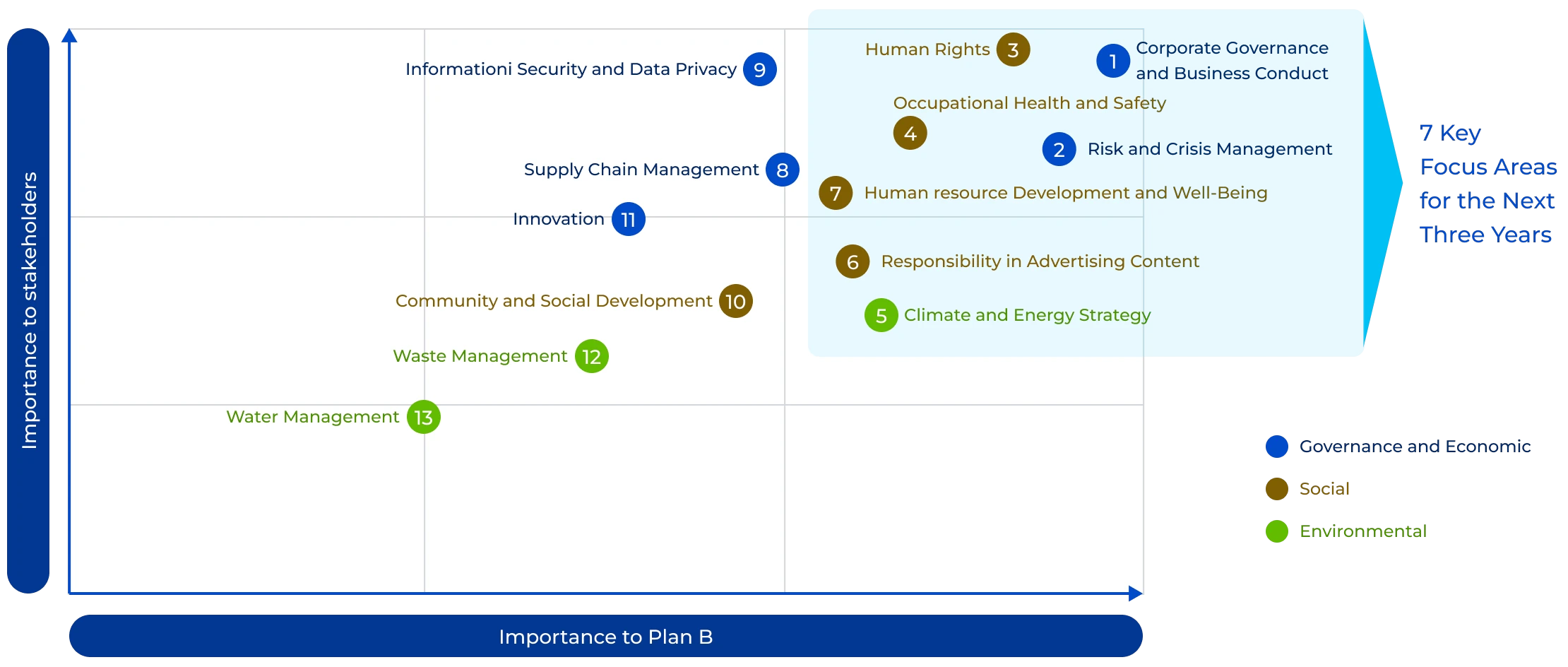
The Board and management have identified 7 strategic material topics for the 2025–2027 period to serve as a framework for sustainability goals, Key Performance Indicators (KPIs), and management plans:

Corporate Governance and Ethics

Human Rights

Climate Strategy and Energy Management

Risk Management

Occupational Health and Safety

Advertising Content Responsibility
Beyond these seven strategic topics, the Company systematically monitors six additional material topics: supply chain management, cybersecurity and data privacy, innovation, social and community development, waste management, and water management. This ensures that business operations across the entire value chain remain responsible and aligned with sustainability principles.
Enhancing the Assessment Process with Double Materiality
In 2025, the Company elevated its assessment process by adopting the Double Materiality concept. This approach provides a clearer identification of critical business risks and opportunities by directly integrating ESG factors into business impact and risk management. The concept evaluates two distinct dimensions:
- Impact Materiality Evaluates the actual and potential positive and negative impacts of the company’s business activities on the economy, environment, and people throughout the value chain, assessed based on scale, scope, and remediability.
- Financial Materiality Evaluates sustainability issues that impact enterprise value, cash flow, financial performance, and access to capital, assessed based on the magnitude of financial impact and the likelihood of occurrence.
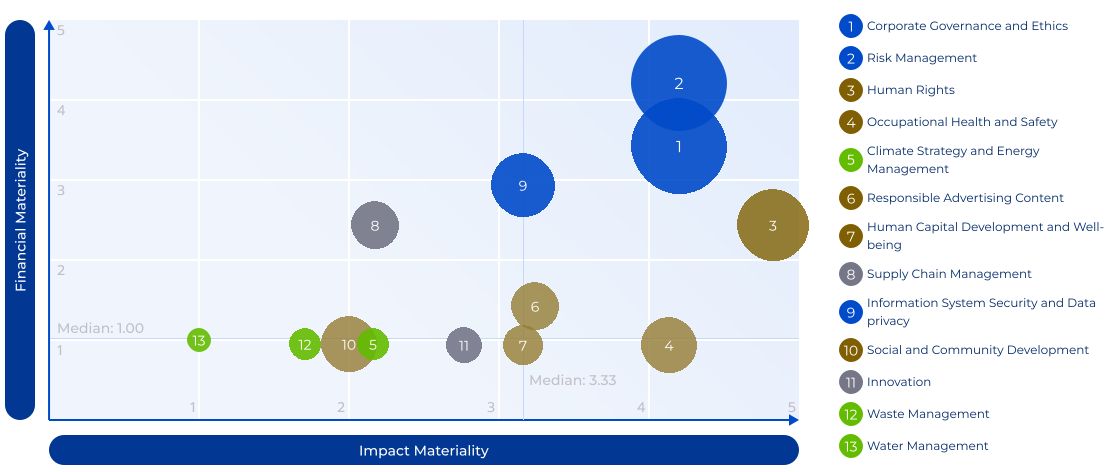
The results of the Double Materiality assessment confirm that the most significant issues across both dimensions are Corporate Governance and Ethics, Risk Management, and Information Security and Data Privacy. This underscores that governance and organizational trust serve as the fundamental foundation for the Company’s ability to create long-term value.
Defining Impact Boundaries
To maximize the efficiency of managing the seven strategic material topics, Plan B has defined impact boundaries that cover the entire business value chain. This includes both internal impacts (activities under the Company’s direct control, such as employee workflows) and external impacts (activities linked to external stakeholders) as follows:
- Environmental Climate strategy and energy management impacts cover energy consumption within offices and advertising screens nationwide. This extends to external impacts on communities, the environment, and national greenhouse gas reduction targets.
- Social Human rights, occupational health and safety, human resource development and well-being, and advertising content responsibility. The scope ranges from the welfare and safety of employees and contractors to external impacts on media consumers and the general public who interact with the Company’s advertising media.
- Economic Corporate governance and risk management. The impact boundary covers the decision-making processes of the Board of Directors and management, which directly affects transparency and the confidence of investors, customers, business partners, and regulatory bodies.
